NewsLetter Capture

Email: *
First Name:
Last Name:

Thursday, April 21, 2011

Eli the Ice Man, glad I remembered you

Image of a small inductor coil 


One can never be sure of the moment where something you learned in nuke school pops into your head at the strangest time.

Most of us are aware much of the information covered in training will not be applicable after your nuke days are finished. There are exceptions, my moment occurred during a job interview where the interviewer asked me the difference between Kilowatts (KW) and Kilo Volts Amperes (KVA). By the way, if you wondering my interview was for a sales engineer position.

I remembered kilowatts were units of power which were equal the product of voltage and current. As for the question posed I knew the relation of KW and KVA had something to do with the lag of the current due to the inductive portion of the current.

Then the phrase, "Eli the Ice-man", came back to me in an instant which I had not thought about since I completed Nuclear Field “A” school over 15 years ago in Orlando, Florida.

With this I composed myself and explained how current lags voltage in an inductive circuit as a result of the time required to generate its magnetic field and how kilowatts expressed the power available to do work and KVA measured the induction component of the power.

The interviewer seemed impressed since I do not hold a B.S. in Electrical Engineering. I still do not understand why I was able to recall Eli during a pressured situation. I guess I should give props to the Navy’s training as painful as it could be at times. Have you ever had a moment like this as an Ex Nuke??

Tuesday, April 19, 2011

Electrical Operator, “Shift the electric plant to Normal Full Power Line Up”


Image of a Syncroscope
For all of you electrical operators out there does this scenario sound familiar? You are in a half power lineup on the port turbine generator.  The Starboard Turbine Generator (TG)is ready to go and you need to bring the TG on the bus restoring the plant to a NFPL and restore the ability the answer bells on both main engines. You know the drill.

What are the things which must occur before you shut a breaker?  For starters the voltage and frequencies of the incoming load and the running bus must match and the synchroscope needs to rotating clockwise prior to shutting the breaker within the gray area at the 12 o clock position on the gauge. Do you remember why? In short, varying frequencies on the generator could speed up or slow down causing damage or excessive power transients. Likewise a variance in voltages can result in transients as well. Proper shutting of the breaker using the synchroscopes ensures the two buses are on phase in addition to ensure the incoming bus picks up the load. 

In any case, normally plant shifts are uneventful. I recall I was on watch as RO and the EO Under Instruction, (UI) was doing a plant shift for qualification. The shift qualified Electric Operator, UI, and the Engineer Officer of the Watch (EOOW) talked through the plant shift prior to operating the plant. Finally, the EOOW gave the order to perform the shift. 

In retrospect, I am not sure of the synchroscope’s position when the UI attempted to shut the breaker. Let’s say the position was nowhere close from the loud boom everyone heard.  After I looked at my panel my pump configuration I lost a pump on each side i.e.1 Slow- 1 Slow. I had two pumps running on each side before the shift.

After the restoring the plant E Div ensured no damage had occurred to the breaker.  On this day we were lucky, for those of you who might not have been so fortunate what was the craziest thing you have seen during a messed up plant shift and what happened afterwards? 

Image courtesy of  http://metersandinstruments.yokogawa-usa.com/product/analog-switchboard-instruments/ab40-synchroscope-switchboard-meters

Tuesday, March 1, 2011

A Look at the Cone

Control Room


I was surfing Facebook pages one evening I noticed some photos posted by someone who used to be on my boat during a Westpac. One of the pictures was of a nuke I served with the caption, “pretty cool for a nuke”. This made me think back to my days as a nuke on submarine and my dealing with my non nuclear trained counterparts.

I know on a lot of boats the nuclear personal does not interact with “coners” especially after submarine qualifications are complete.  Fortunately, our boat operated a little differently since we all got along pretty well. My roommate was a mess cook and we are still in touch to this day. A quick glance at Facebook revealed a lot of “coners” are connected as friends with ex nukes even though it had been almost a decade since we all lived and worked on the boat.

Numerous “coners” were nukes who did not make through the nuclear pipeline for one reason or another. But once you arrived at the boat “coners” enjoyed more liberty and, perhaps lived with lowered stress levels, less duty and working hours and still left with the same DD214 nukes received upon leaving the service.

 For the record, I can agree with the cone on the fact some nukes can be difficult to work with. I have found lots of Nukes to be obnoxious and condescending. These flaws, in many instances, have made them unpopular on both sides of the engine room hatch.

We all serve same nation, enjoy equal veteran status, and would wind up on the identical eternal patrol if it came down to not coming home. The aft portion of the boat may push but the cone navigates, drives, and when necessary shoots, all which are needed in order for a submarine to complete its missions. In closing I would like to thank those “coners” who chose to judge nukes by the kind of people they are instead by their rating.  

Monday, February 21, 2011

Considering going nuke and concerned about radiation? Relax.

How much radiation should to expect to get?


One of the considerations I have heard about joining the Navy’s nuclear program is the quantity of radiation absorbed during your time in the propulsion plant.

The experts say you will take in more by the nature of the job description then the normal civilian. What is not as well known is the amount of energy you and I absorb living on the planet earth on a daily basis.

On average a person absorbs 360 millirem (mrem) of radiation every year. The exposure is broken down into human and background sources. Human generated emissions comprise x-rays, consumer products, for example televisions, older luminous dial watches and some smoke detectors. Industrial sources are counted as being generated by humans and include radiography which is used to test pipe welds. Background sources contain cosmic radiation, which comes from the sun and outer space, in the earth's crust, and finally, from the human body, for example, the natural radio-nuclides Potassium 40 present in human tissue.

The radiation from the earth in the ground comes from rocks, building materials and drinking water supplies. Radon gas is by far the largest health hazard. The gas is formed from the decay of natural uranium in soil.
During my time as a Reactor Operator the ELT’s used Thermal luminescence dosimeters (TLD’s) to measure the rays absorbed by each nuke on a monthly basis. I do not have a recollection of my totals but I am sure it did not exceed 50 mrem a year for any of the years I was a Reactor Operator. And I was in Reactor Controls (RC) division who on occasion went into the reactor compartment after shutdowns to perform maintenance.

In summary, you will receive more exposure with respect to the mrems received from the environment. The incremental amount will be relatively small. I could make the argument if your orders wind up sending you to a submarine averaging 250 days of the year underway will reduce you exposure further. Do anyone worry about the radiation they pick up while going to the beach on a sunny day. Therefore, if you decide not to through the nuclear pipeline there are more valid reasons than concerns about exposure. Some of which will be covered in future posts.

Saturday, January 8, 2011

Every Little Person Loves the Funny Navy

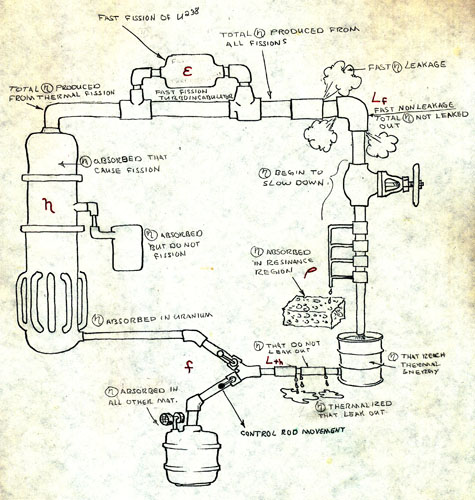
Does anyone remember this moniker? Here is a clue, the moniker was introduced when we all attended Nuke school and the learned about the operation of a nuclear reactor during Reactor Principles. This led to the discussion of the sources of the thermal neutrons which allow nuclear plants to become critical and generate energy through the splitting of Uranium.

I’ll let the secret out, Ever Little Person Loved the Funny Navy stands the six factors of neutron multiplication. Do you remember what these are? For those of us who may not remember since it has been many years since nuke school the factors are:

1. The fast fission factor symbolized by the Greek symbol, e
2. The fast non-leakage probability which is symbolized by Lf
3. The resonance escape probability represented by p
4. The thermal non-leakage probability, Lt
5. The thermal utilization factor, f
6. The thermal fission factor or reproduction factor characterized by the letter n.

These six factors give the highlights of the numbers of neutrons available in a nuclear reactor.
To look at this from the vantage of a neutron the journey to causing fission event begins with a fast (with energy greater than thermal energies) neutron that has been generated by the fission of a uranium atom bombarded with a neutron. Either one of two things can occur; it can leak from out of the reactor or not. Neutrons which leak out are no good to us. Therefore the probability of neutrons which do not leak when while will be the neutrons which are still available to cause fissions. This is defined as Lf. From there these neutrons can do one of two things either slow to energies closer to the molecules around them or be absorbed. As our goal is to get thermal neutrons we are interested in the likelihood of neutrons that are not absorbed and are slowed to thermal energies. This is identified as p the resonance escape probability. Remember the fast neutrons which started this discussion? They can cause fission events as well. The odds of this occurrence are called e the probability of fission from fast neutrons. Returning back to our thermal electrons in the same fashion as the fast electrons they can leak from out of the reactor or not leak. Those which remain are known as Lt which is the probability of thermal neutrons not to leak, and thus be available to create fission events. At this point our thermal neutron can either be either absorbed in some materials or absorbed in our fuel. The likelihood the thermal neutron is absorbed in the fuel is referred to as f, the thermal utilization factor. Finally every neutron absorbed in the fuel does not necessarily cause a fission event. Therefore the probability of a neutron causing a fission event and is not captured once is absorbed by the fuel is defined as n.

With that said who cares? Of course, the nerdy nuke in everyone who has ever attended naval nuclear power school, some of which read this posting the very end…...

Image courtesy of http://www.jensen-graphics.com/Neutron.html

Tuesday, January 4, 2011

My Recollections of Navy Prototype


I remember being told the purpose of the six month prototype tour after graduating nuclear power school was to prepare you for qualifying on your boat upon your arrival. Not to discredit what anyone told me while I was a Nuke as the absolute truth but here is what I got out of my six months in Charleston.

1) What is like to stuck on a boat
I remember being on the boat for hours at a time. Yes, you lived in South Carolina and weren’t missing out on the best party scene but I am sure there were other activities that would have used my time more effectively. Looking back at the ORSE workups I went through once I got to my boat I should have a complained less. At least I didn’t need to clean after finishing drill sets with multiple fires drills with EAB’s in ERLL.

2) Midnight watches - sleep all day and still get no real rest
My time at NPTU marked the first time I had to work on the mid-watch. I would try all kinds of tricks in order to get a good night’s sleep, some included eating a solid meal prior to going to sleep, drinking heavy quantities alcohol, and partying all night in the days prior to my rotations. All told I never got any decent rest and was still brain dead during my shifts. Which didn’t make me popular with my C-DAD, Shane Rye what ever happened to you?

3) Practice at the game of qualifying
NPTU was where I received indoctrination to Qualification cards and playing to enough signatures to get to a board and enough knowledge to entertain some shot at passing. The reality is you would never know as much as the sea returnees therefore the trick was to optimize the mix of signature and knowledge all while avoiding extra military instruction (EMI). I get the fact the point was to become familiar with the reactor systems enough to go to our boats and qualify. I still would stand no patrol on a decommissioned 578 class boat operating a water brake into the Charleston River.

4) The true meaning of run time - on a watch I would do not duty on
Yes, my favorite run-time. This amounted to free abuse from the sea returnees, all in preparation of going to our sea commands as nubs. My recollections are summarized as such, Petty officer Green, tell me about this casualty on my propulsion plant. My thought to myself, ”No, you tell me”. Aren’t I the student after all? In the end I felt stupid with a bunch of look ups to hunt down about an engine room I would not stand a day of duty on in service of my country.

5) Get in trouble for a scram of a simulator
The time for drills has come again. This time we enter the simulator which is not unlike the maneuvering area on a submarine. At least their gauges are monitoring a propulsion plant. I sit as the RO with my C-Dad wondering what the hell is wrong with me as my gauges go up and down and why I have no real clue as to what these indications all mean. Damn, did I exceed my power limit during that pump shift? I guess my rod bottom lights and decreasing power level into the intermediate range aren’t a faulty indication. What remedial punishment will they come up with for this screw-up? Can I still get my card signed? Can they simulate the board which I will need to pass to get to my sea command??

Please bear in mind these are my experiences and everyone many be different. However if you are looking for more information on Prototype? Here is a Squidoo lens which covers the topic of Prototype very nicely.

http://www.squidoo.com/prototypeschool

If you can relate to what you read and wanted to sound off please do not hesitate to comment. Please make sure to follow us on Twitter @Ex_Navy_Nuke

Image courtesy of http://www.cnrc.navy.mil/nucfield/today/prototype.htm

Monday, November 1, 2010

Ex Navy Nuke Gear for you to wear

The day after standing the SRO mid-watch is not the time to think about wearing nuclear related clothing to show off to the outside world. I am sure we all remember days where you barely wanted to wear your issued dungaree uniform.

What about those dungarees? These were the official, work uniform of the Navy blue-shirt which, interestingly enough could not be worn off base other than to drive to base to and from duty/work.

After your time if obligated service is complete on a few occasions you might want to show your pride of being a Nuke after your tour is complete and you can live like a regular human being. Once you stopped participating field days and going through ORSE workups you may take pride in being a nuke, being in the Navy and most importantly serving your country with distinction.

Before you never really been in a position to get the nuke related tee shirt other than the one you were issued during boot camp or purchased after the completion of A School. Not until now.

Think about the idea of wearing your Ex-Navy gear out in the civilian world knowing the folks you will encounter will have little clue of the places you have been, the things you’d seen, and the hardships endured during you time as a Nuke.

If you are interested in getting Navy nuke gear on a nostalgia basis check out this site where to get Navy Nuke gear and place your order. And tell them this blog sent you.


If you can relate to what you read and wanted to sound off please feel free to comment.  Please make sure to follow us on Twitter @Ex_Navy_Nuke