NewsLetter Capture

Email: *
First Name:
Last Name:

Monday, February 21, 2011

Considering going nuke and concerned about radiation? Relax.

How much radiation should to expect to get?


One of the considerations I have heard about joining the Navy’s nuclear program is the quantity of radiation absorbed during your time in the propulsion plant.

The experts say you will take in more by the nature of the job description then the normal civilian. What is not as well known is the amount of energy you and I absorb living on the planet earth on a daily basis.

On average a person absorbs 360 millirem (mrem) of radiation every year. The exposure is broken down into human and background sources. Human generated emissions comprise x-rays, consumer products, for example televisions, older luminous dial watches and some smoke detectors. Industrial sources are counted as being generated by humans and include radiography which is used to test pipe welds. Background sources contain cosmic radiation, which comes from the sun and outer space, in the earth's crust, and finally, from the human body, for example, the natural radio-nuclides Potassium 40 present in human tissue.

The radiation from the earth in the ground comes from rocks, building materials and drinking water supplies. Radon gas is by far the largest health hazard. The gas is formed from the decay of natural uranium in soil.
During my time as a Reactor Operator the ELT’s used Thermal luminescence dosimeters (TLD’s) to measure the rays absorbed by each nuke on a monthly basis. I do not have a recollection of my totals but I am sure it did not exceed 50 mrem a year for any of the years I was a Reactor Operator. And I was in Reactor Controls (RC) division who on occasion went into the reactor compartment after shutdowns to perform maintenance.

In summary, you will receive more exposure with respect to the mrems received from the environment. The incremental amount will be relatively small. I could make the argument if your orders wind up sending you to a submarine averaging 250 days of the year underway will reduce you exposure further. Do anyone worry about the radiation they pick up while going to the beach on a sunny day. Therefore, if you decide not to through the nuclear pipeline there are more valid reasons than concerns about exposure. Some of which will be covered in future posts.

Saturday, January 8, 2011

Every Little Person Loves the Funny Navy

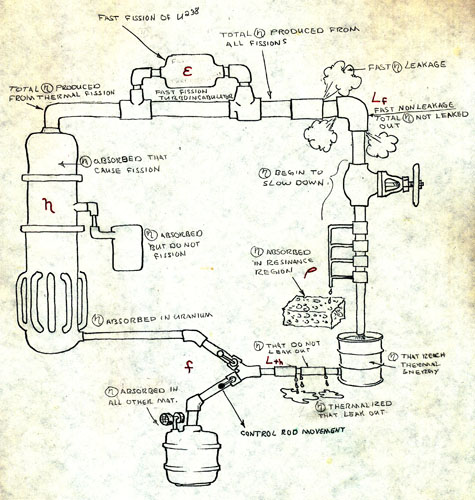
Does anyone remember this moniker? Here is a clue, the moniker was introduced when we all attended Nuke school and the learned about the operation of a nuclear reactor during Reactor Principles. This led to the discussion of the sources of the thermal neutrons which allow nuclear plants to become critical and generate energy through the splitting of Uranium.

I’ll let the secret out, Ever Little Person Loved the Funny Navy stands the six factors of neutron multiplication. Do you remember what these are? For those of us who may not remember since it has been many years since nuke school the factors are:

1. The fast fission factor symbolized by the Greek symbol, e
2. The fast non-leakage probability which is symbolized by Lf
3. The resonance escape probability represented by p
4. The thermal non-leakage probability, Lt
5. The thermal utilization factor, f
6. The thermal fission factor or reproduction factor characterized by the letter n.

These six factors give the highlights of the numbers of neutrons available in a nuclear reactor.
To look at this from the vantage of a neutron the journey to causing fission event begins with a fast (with energy greater than thermal energies) neutron that has been generated by the fission of a uranium atom bombarded with a neutron. Either one of two things can occur; it can leak from out of the reactor or not. Neutrons which leak out are no good to us. Therefore the probability of neutrons which do not leak when while will be the neutrons which are still available to cause fissions. This is defined as Lf. From there these neutrons can do one of two things either slow to energies closer to the molecules around them or be absorbed. As our goal is to get thermal neutrons we are interested in the likelihood of neutrons that are not absorbed and are slowed to thermal energies. This is identified as p the resonance escape probability. Remember the fast neutrons which started this discussion? They can cause fission events as well. The odds of this occurrence are called e the probability of fission from fast neutrons. Returning back to our thermal electrons in the same fashion as the fast electrons they can leak from out of the reactor or not leak. Those which remain are known as Lt which is the probability of thermal neutrons not to leak, and thus be available to create fission events. At this point our thermal neutron can either be either absorbed in some materials or absorbed in our fuel. The likelihood the thermal neutron is absorbed in the fuel is referred to as f, the thermal utilization factor. Finally every neutron absorbed in the fuel does not necessarily cause a fission event. Therefore the probability of a neutron causing a fission event and is not captured once is absorbed by the fuel is defined as n.

With that said who cares? Of course, the nerdy nuke in everyone who has ever attended naval nuclear power school, some of which read this posting the very end…...

Image courtesy of http://www.jensen-graphics.com/Neutron.html

Tuesday, January 4, 2011

My Recollections of Navy Prototype


I remember being told the purpose of the six month prototype tour after graduating nuclear power school was to prepare you for qualifying on your boat upon your arrival. Not to discredit what anyone told me while I was a Nuke as the absolute truth but here is what I got out of my six months in Charleston.

1) What is like to stuck on a boat
I remember being on the boat for hours at a time. Yes, you lived in South Carolina and weren’t missing out on the best party scene but I am sure there were other activities that would have used my time more effectively. Looking back at the ORSE workups I went through once I got to my boat I should have a complained less. At least I didn’t need to clean after finishing drill sets with multiple fires drills with EAB’s in ERLL.

2) Midnight watches - sleep all day and still get no real rest
My time at NPTU marked the first time I had to work on the mid-watch. I would try all kinds of tricks in order to get a good night’s sleep, some included eating a solid meal prior to going to sleep, drinking heavy quantities alcohol, and partying all night in the days prior to my rotations. All told I never got any decent rest and was still brain dead during my shifts. Which didn’t make me popular with my C-DAD, Shane Rye what ever happened to you?

3) Practice at the game of qualifying
NPTU was where I received indoctrination to Qualification cards and playing to enough signatures to get to a board and enough knowledge to entertain some shot at passing. The reality is you would never know as much as the sea returnees therefore the trick was to optimize the mix of signature and knowledge all while avoiding extra military instruction (EMI). I get the fact the point was to become familiar with the reactor systems enough to go to our boats and qualify. I still would stand no patrol on a decommissioned 578 class boat operating a water brake into the Charleston River.

4) The true meaning of run time - on a watch I would do not duty on
Yes, my favorite run-time. This amounted to free abuse from the sea returnees, all in preparation of going to our sea commands as nubs. My recollections are summarized as such, Petty officer Green, tell me about this casualty on my propulsion plant. My thought to myself, ”No, you tell me”. Aren’t I the student after all? In the end I felt stupid with a bunch of look ups to hunt down about an engine room I would not stand a day of duty on in service of my country.

5) Get in trouble for a scram of a simulator
The time for drills has come again. This time we enter the simulator which is not unlike the maneuvering area on a submarine. At least their gauges are monitoring a propulsion plant. I sit as the RO with my C-Dad wondering what the hell is wrong with me as my gauges go up and down and why I have no real clue as to what these indications all mean. Damn, did I exceed my power limit during that pump shift? I guess my rod bottom lights and decreasing power level into the intermediate range aren’t a faulty indication. What remedial punishment will they come up with for this screw-up? Can I still get my card signed? Can they simulate the board which I will need to pass to get to my sea command??

Please bear in mind these are my experiences and everyone many be different. However if you are looking for more information on Prototype? Here is a Squidoo lens which covers the topic of Prototype very nicely.

http://www.squidoo.com/prototypeschool

If you can relate to what you read and wanted to sound off please do not hesitate to comment. Please make sure to follow us on Twitter @Ex_Navy_Nuke

Image courtesy of http://www.cnrc.navy.mil/nucfield/today/prototype.htm

Monday, November 1, 2010

Ex Navy Nuke Gear for you to wear

The day after standing the SRO mid-watch is not the time to think about wearing nuclear related clothing to show off to the outside world. I am sure we all remember days where you barely wanted to wear your issued dungaree uniform.

What about those dungarees? These were the official, work uniform of the Navy blue-shirt which, interestingly enough could not be worn off base other than to drive to base to and from duty/work.

After your time if obligated service is complete on a few occasions you might want to show your pride of being a Nuke after your tour is complete and you can live like a regular human being. Once you stopped participating field days and going through ORSE workups you may take pride in being a nuke, being in the Navy and most importantly serving your country with distinction.

Before you never really been in a position to get the nuke related tee shirt other than the one you were issued during boot camp or purchased after the completion of A School. Not until now.

Think about the idea of wearing your Ex-Navy gear out in the civilian world knowing the folks you will encounter will have little clue of the places you have been, the things you’d seen, and the hardships endured during you time as a Nuke.

If you are interested in getting Navy nuke gear on a nostalgia basis check out this site where to get Navy Nuke gear and place your order. And tell them this blog sent you.


If you can relate to what you read and wanted to sound off please feel free to comment.  Please make sure to follow us on Twitter @Ex_Navy_Nuke

Sunday, October 24, 2010

Boot camp for a nuke

I'm in boot camp now what have I done?
The transition into military life can be challenging for anyone. Boot camp is the place where through the physical and mental training you are transitioned from being a civilian into the member of the world finest Navy. The process can be especially challenging for someone recruited into the Navy to go nuke.

Numerous reasons exist including many nukes are not popular with their non nuke counterparts. Another reason was many nuke pre boot camp experience, gave them no heads up on the rigors of military life.

I recalled my time in basic training in Orlando from March to May 1994. Some companies who were loaded with recruits who had chosen to go nuke. Many of the company commanders, who for whatever reason had some bad experiences with nukes and seemed determined to pay these recruits, pay the price.

During my 8 weeks at Naval Training Center there were five major takeaways which I took away long after the completion of my time as a nuke. My first and most important one, involved learning of the E1 – E7 relationship. As E1 you didn’t speak advice or suggest, you followed instructions. Thanks goodness for advancement. The second thing emphasized the importance of finishing the job. I remember my getting a discipline in ranks (DIR) for a bunk inspection before I moved after trying to nudge my book back into its pocket before time was called. Of course, since my bunk was perfect the cycling which came later felt that much worse. The other insight I took away, after looking back, is the mental aspect to everything. I would have stressed a lot less had I been less afraid of everything in boot-camp. The process consisted of a game to get to the start of the rest of your Navy career. I guess its water under the bridge now. The final takeaway is even though I had designated going nuke why did I need to learn about putting out fires and tying knots? The answer seemed simple, I was in the Navy now like all of the other poor bastards who volunteered themselves.

Now with my lessons in hand all good things come, including boot camp, come to an end. And for us nukes the fun would be just beginning. The time for A school had arrived, at least now you get off base, albeit, on rare occasions.

Photo courtesy of  http://thepowerof3.typepad.com/deborah/2010/06/index.html

If you can relate to what you read and wanted to sound off please feel free to comment.  Please make sure to follow us on Twitter @Ex_Navy_Nuke

Sunday, October 3, 2010

A Smaller Nuke Plant

Any nuke that has completed a sea tour will be able to tell you a smaller sized nuclear power plant can supply more than enough power in a method which is clean in comparison to fossil fuel.
It seems the civilian community seems to be beginning to figure this out. The debate on whether increasing the 20% of our nation power needs nuclear power have been argued as an alternative from conventional source of power generation. To cause a significant impact this option would be MW sized power plant used to supply to regional power requirements. A typical reactor used in a commercial plant is typically rated for 1700 MW.

What is not as well known is the effect smaller size nuclear plants, like the one we operated, might provide. These smaller reactors range in between 30 to 300 Megawatts of output.
The main attraction for both electrical utilities and reactor builders is the potential cost savings: Producing electricity may possibly be 10–20% cheaper per kilowatt-hour than with a standard reactor.

In spite of this all is not clear to see a growth of small scale nukes. Unlike the navy in the civilian world there will still be regulatory, technical, and licensing hurdles. So to those of you who are thinking of dumping all of the knowledge assembled in two years of nuclear training and four years of standing watch in your boat.

Keep your eyes out for these three companies which manufacture and market modular nuclear reactors namely Westinghouse, NuScale Power, and Babcock and Wilcox Co. If you are getting ready to get out and are spooked at about continuing your nuclear career and hit these companies up for jobs. With your training and ability they would love to hear from you.


If you can relate to what you read and wanted to sound off please feel free to comment.  Please make sure to follow us on Twitter @Ex_Navy_Nuke

Wednesday, April 14, 2010

Three things in a seabag

Image of a seabag
It seems like yesterday when I finished packing my stuff for the final move to my new home once I left the Navy. Due to logistics I was able to take so many things off of the rock (a.k.a. Hawaii) on my move. I looked at all of my uniforms, clearly, I would not be standing duty anymore duty. I had never been so excited to throw so much stuff in the dumpster in the parking lot of my apartment complex.

In retrospect once I had settled in my post Navy job I made a mental note of three common items contained in the sea bag I wished I had kept for use once I left the Navy.
The first thing, as a submariner, I should have held onto was my poppie suit (submarine overalls). These are ideal for working under the hood of your car or working in the basement. Purchasing one for $20.00 bucks at your local Wal-Mart seems silly when the Navy had issued you one for nothing. All you had to do is take the insignia off and you were in business.
The second thing was the pea coat. For those of you living in colder climates this is the ideal outer garment. Think about the possibilities, if the pea coat could get you through a Great Lakes (Mistakes) boot camp during winter then it should enable you to survive any cold weather situation. Interesting enough a few civilian companies that manufacture these types of coats and which people buy retail.

The last thing is the sea bag itself. Your move once you get out of the navy will probably not be your last move. The durability of the coat to store unlimited junk makes this piece of Navy gear invaluable for carrying all of the odds and ends that are associates with any move.
I realize once you are with single digit days of the freedom you imagined once you checked into your boat and realized the last four years of your life were going to soon be a memory other pressing concerns to address. Yet still, perhaps this may be something you might want to think about.

Photo courtesy of http://shop.ebay.com

If you can relate to what you read and wanted to sound off please feel free to comment.  Please make sure to follow us on Twitter @Ex_Navy_Nuke